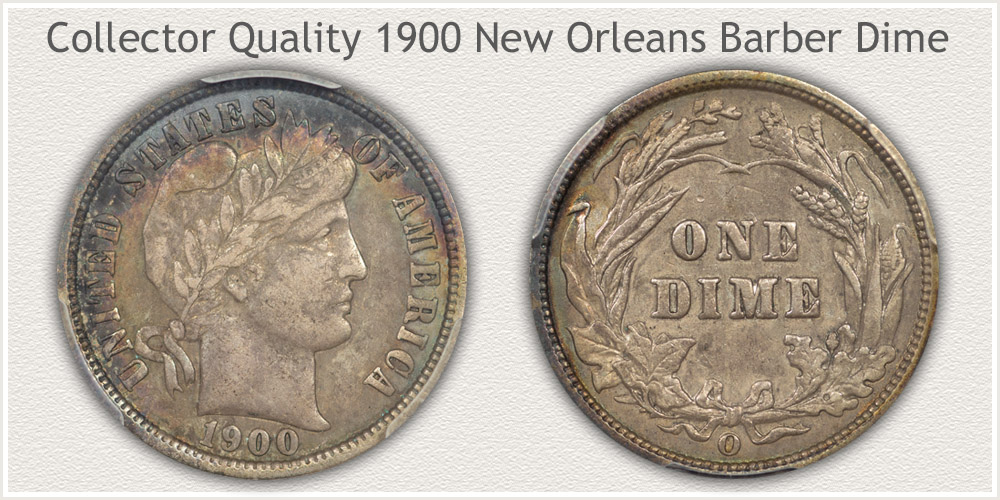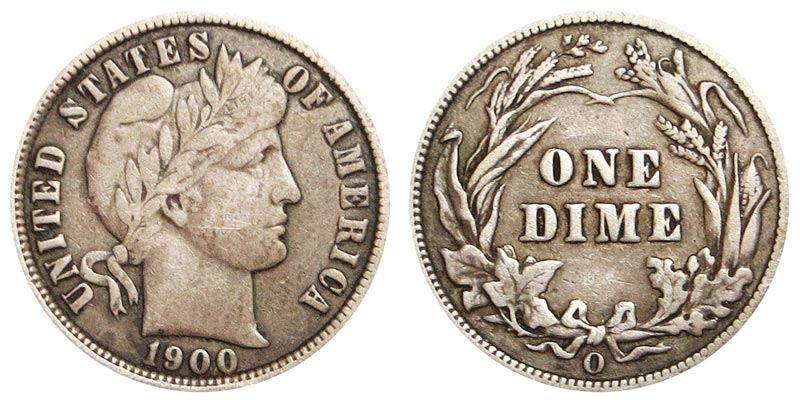
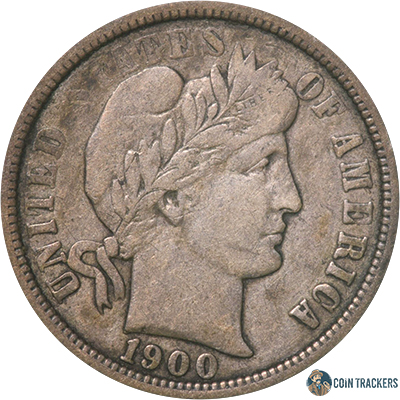
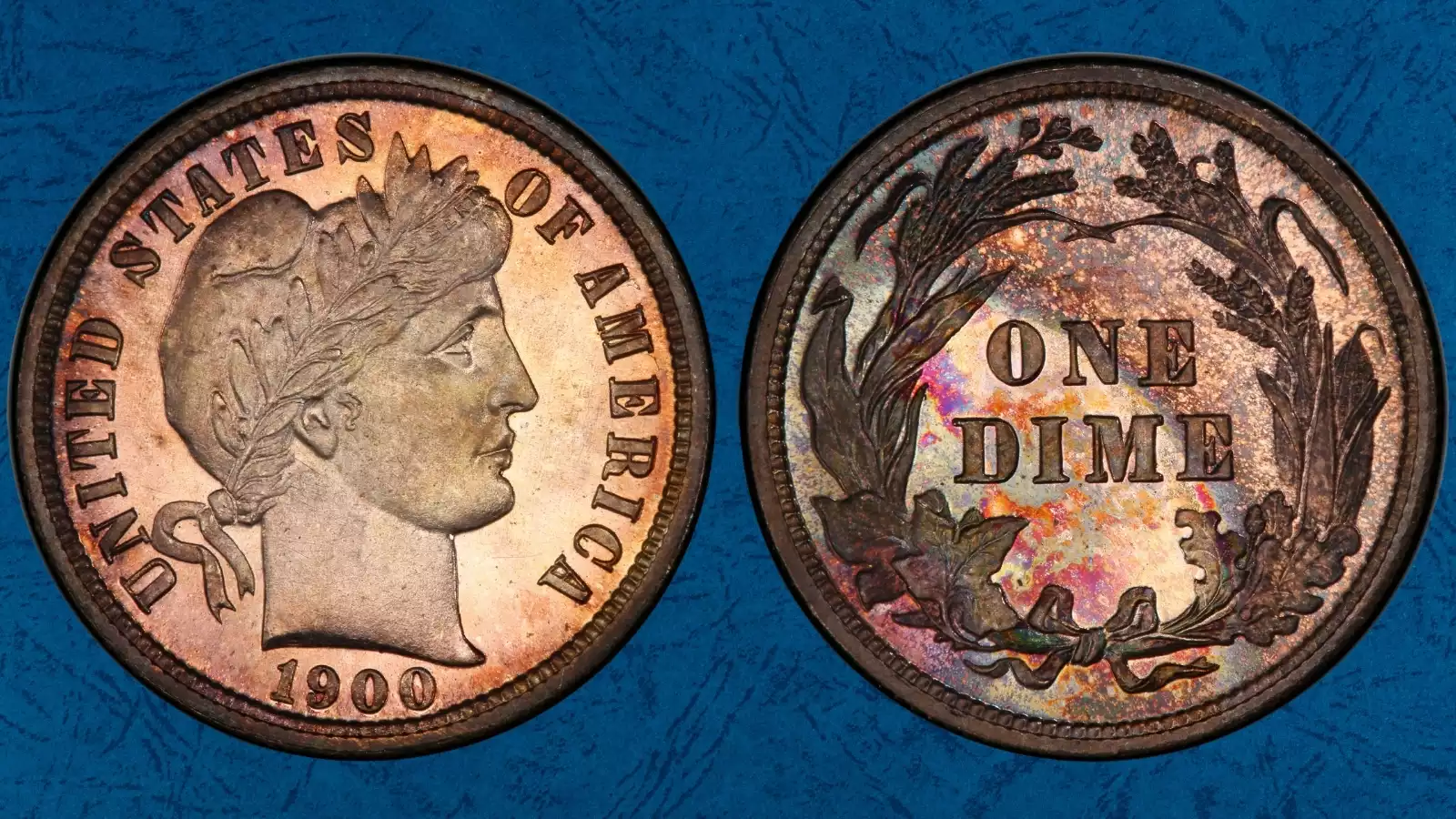
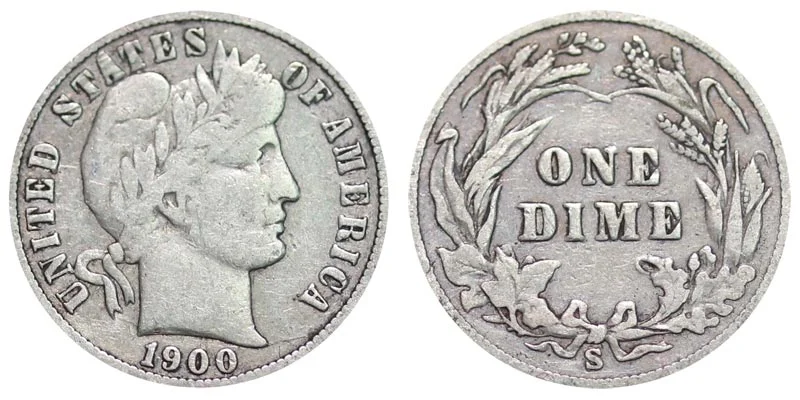
1900 Barber dime obverse and reverse showing Liberty portrait and eagle wreath

The 1900 Barber Dime Value Guide

A gem MS67 example sold at Heritage Auctions for $8,625 — while circulated coins trade for as little as $9. The difference? Mint mark, condition, and knowing what to look for. This guide covers all three 1900 mints, every major error, and the tools to find your coin's true worth.

★★★★★ 4.8 stars · 1,247 collectors rated this tool
Check My 1900 Dime Value →
$8,625
Top auction record (MS67 · Heritage)
$12,650
1900-O record (MS66 · Heritage)
24.8M
Total 1900 dimes struck (all mints)
912
Proof coins struck (Philadelphia)

1900 Barber Dime Value Chart at a Glance

Before running the calculator below, use this table to quickly locate your coin's approximate range. For a complete illustrated 1900 Barber dime identification walkthrough, including full-resolution photos of each grade, check the linked resource. Values reflect recent realized auction and dealer prices — individual coins may vary.

Variety Good (G4–G6) Fine (F12–F15) AU (50–58) Mint State (MS62–MS64) Gem (MS65+)
1900-P (No Mint Mark) $8 – $13 $17 – $31 $90 – $190 $190 – $330 $1,600+
🔴 1900-O (New Orleans) $17 – $35 $95 – $200 $375 – $450 Key Rarity $12,650 record
⭐ 1900-S (San Francisco) $12 – $20 $25 – $50 $100 – $235 $365 – $600 $1,920 – $5,170
1900 Proof (PR65) $960 – $1,400 $1,620 – $5,940
1900 Proof DCAM (PR67) $8,625 – $10,500+

🔴 Red row = key rarity. ⭐ Gold row = signature variety (most-searched). Values are retail estimates based on Heritage Auctions, PCGS Price Guide, and PriceCharting data.

🪙 CoinKnow lets you snap a photo of your 1900 dime and instantly estimate its grade and value on the go — a coin identifier and value app.

Quick Navigation

Jump to any section of this guide:

The Valuable 1900 Barber Dime Errors — Complete Guide

Beyond the three standard mint-mark varieties, a small number of 1900 Barber dimes escaped the U.S. Mint with production errors that make them far more fascinating — and considerably more valuable — than standard examples. The five varieties below cover the most documented and actively traded errors in order of typical premium. Each card identifies what the error looks like, where to find it, and why collectors pay up.

1900-O Barber dime reverse showing New Orleans O mint mark below wreath bow Most Famous

1900-O New Orleans Key Date

$17 – $12,650+

The 1900-O Barber dime is the undisputed key rarity among the three 1900 business strikes. With only 2,010,000 coins struck at the New Orleans Mint — the lowest mintage of any 1900 dime issue — surviving examples in collectible grades are genuinely scarce. The New Orleans facility was notorious for using worn dies and applying inconsistent striking pressure, compounding the rarity of well-preserved specimens.

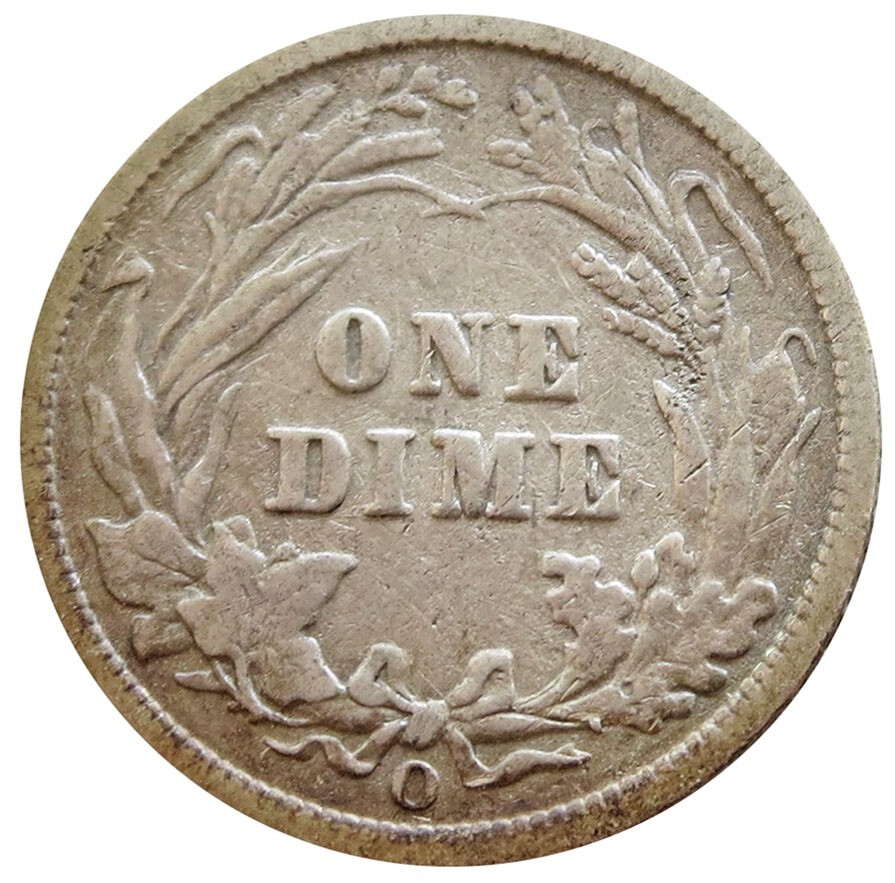
Visually, the 1900-O stands apart from its Philadelphia and San Francisco siblings by the distinctive "O" mint mark placed on the reverse below the wreath ribbon bow. More importantly, New Orleans dimes of this period frequently show softness in Liberty's hair above the headband and in the central wreath on the reverse — even on coins that show little circulation wear. This strike weakness is not damage; it is a factory characteristic that graders account for, but it means fewer coins achieve higher numerical grades.

In Mint State condition, the 1900-O is classified as a key rarity. Fewer than a handful of MS64 or finer examples are known to PCGS and NGC combined. The Heritage Auctions record of $12,650 for an MS66 example set in 2005 remains one of the highest prices realized for any standard 1900 Barber dime. Even circulated examples in Fine to About Uncirculated condition command two to three times the premium of equivalent Philadelphia coins, making any 1900-O worth identifying carefully.
How to spot it

Look on the reverse below the wreath bow ribbon knot for an "O" mint mark. In worn grades the "O" can be flat — use a 10× loupe and tilt under raking light to see even a faint impression distinct from a blank field.

Mint mark

O (New Orleans Mint only). Mintage: 2,010,000 — lowest of the three 1900 business-strike issues.

Notable

Heritage Auctions MS66 example realized $12,650 in 2005. Mint State population is extremely thin across both PCGS and NGC registries, with virtually no examples above MS64 confirmed in recent census reports.

1900-O Barber dime mint mark area under magnification showing repunched O mint mark shadow impression Most Valuable Error

Repunched Mint Mark (RPM)

$30 – $300+

Repunched Mint Mark (RPM) varieties occur when the mint mark punch was applied to the working die more than once, and the second impression landed slightly offset from the first. On 1900 Barber dimes, this phenomenon is most productive on New Orleans "O" issues and San Francisco "S" issues, because mint marks were hand-applied to each working die individually — a process inherently prone to minor misalignment. Under magnification, a secondary or shadow impression of the mint mark is visible beside, above, or partially overlapping the primary letter.

To identify a 1900 RPM, examine the mint mark under a 10× loupe under consistent raking light. The telltale sign is a raised secondary curve or serif adjacent to the primary mint mark letter — not a rim scratch, which would be incuse. On a genuine RPM, both the primary and secondary impressions are raised and have the characteristic soft rounded profile of a die-punched letter. The offset direction and distance help distinguish one RPM die variety from another.

Premium value depends on the mint mark, the coin's overall grade, and how dramatically offset the secondary punch appears. On circulated 1900-O examples in Fine or better condition, a confirmed RPM attribution typically adds $30 to $100 over standard pricing. Well-documented, widely-offset RPMs on the scarce 1900-O in AU or better can command significantly more from variety specialists. Third-party attribution through PCGS or NGC is strongly recommended for any specimen you believe carries a meaningful RPM premium.
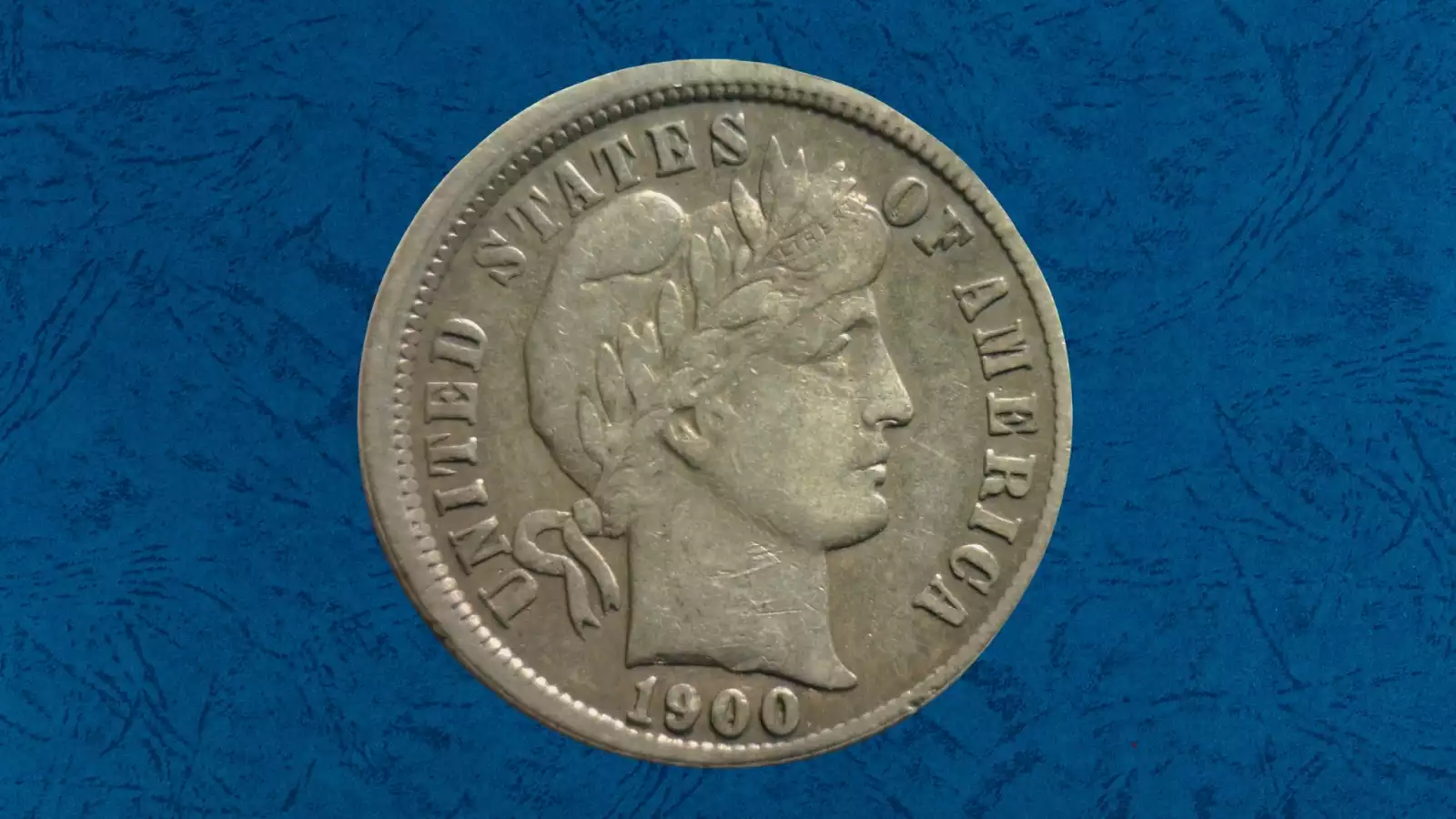
How to spot it

Use a 10× loupe under raking light at the mint mark. Look for a raised secondary curve or partial letter impression adjacent to the primary "O" or "S" — not a flat scratch. Both impressions will be raised metal, not incuse.

Mint mark

O (New Orleans) and S (San Francisco) issues only. Philadelphia coins have no hand-punched mint mark, so RPM is not applicable.

Notable

RPM varieties on 1900-O Barber dimes are actively pursued by Barber dime specialists. Attribution through CONECA or Cherrypickers' Guide is recommended before pricing. Confirmed examples in Fine or better add $30–$100+ over standard value.

1900 Barber dime with off-center strike showing design shifted with blank crescent of planchet on one side Most Dramatic

Off-Center Strike

$50 – $500+

An off-center strike occurs when the planchet (blank coin disc) is not perfectly centered between the dies at the moment of striking. The result is a coin where the complete design appears shifted to one side, with a corresponding crescent-shaped area of blank, unstruck planchet visible on the opposite side. On 1900 Barber dimes, this error is an exciting discovery because the small size and silver content of these coins make minor off-center examples easy to overlook in a roll or junk lot.

Identifying an off-center 1900 Barber dime is straightforward visually: Liberty's portrait will be shifted toward one edge of the coin, and a visible wedge or crescent of plain silver planchet will be present on the opposite side. The degree of offset is measured as a percentage — a 10% off-center leaves a narrow sliver of blank metal, while a 50% off-center leaves half the design missing. The most valuable examples are those where the date remains fully readable despite significant centering displacement, as the date confirms the coin's identity and year.

Collector demand for off-center Barber dimes is strong, particularly among error-coin specialists who prefer dramatic, visually obvious strikes. Minor misalignments of 5–10% add a $50–$100 premium in circulated condition. More dramatic strikes at 20–30% off-center, where the date is still clearly legible, can reach $200–$500 or more. The premium scales with both the degree of offset and the coin's overall preservation — an uncirculated off-center Barber dime with a bold date is a genuine show-stopper that commands top dollar.
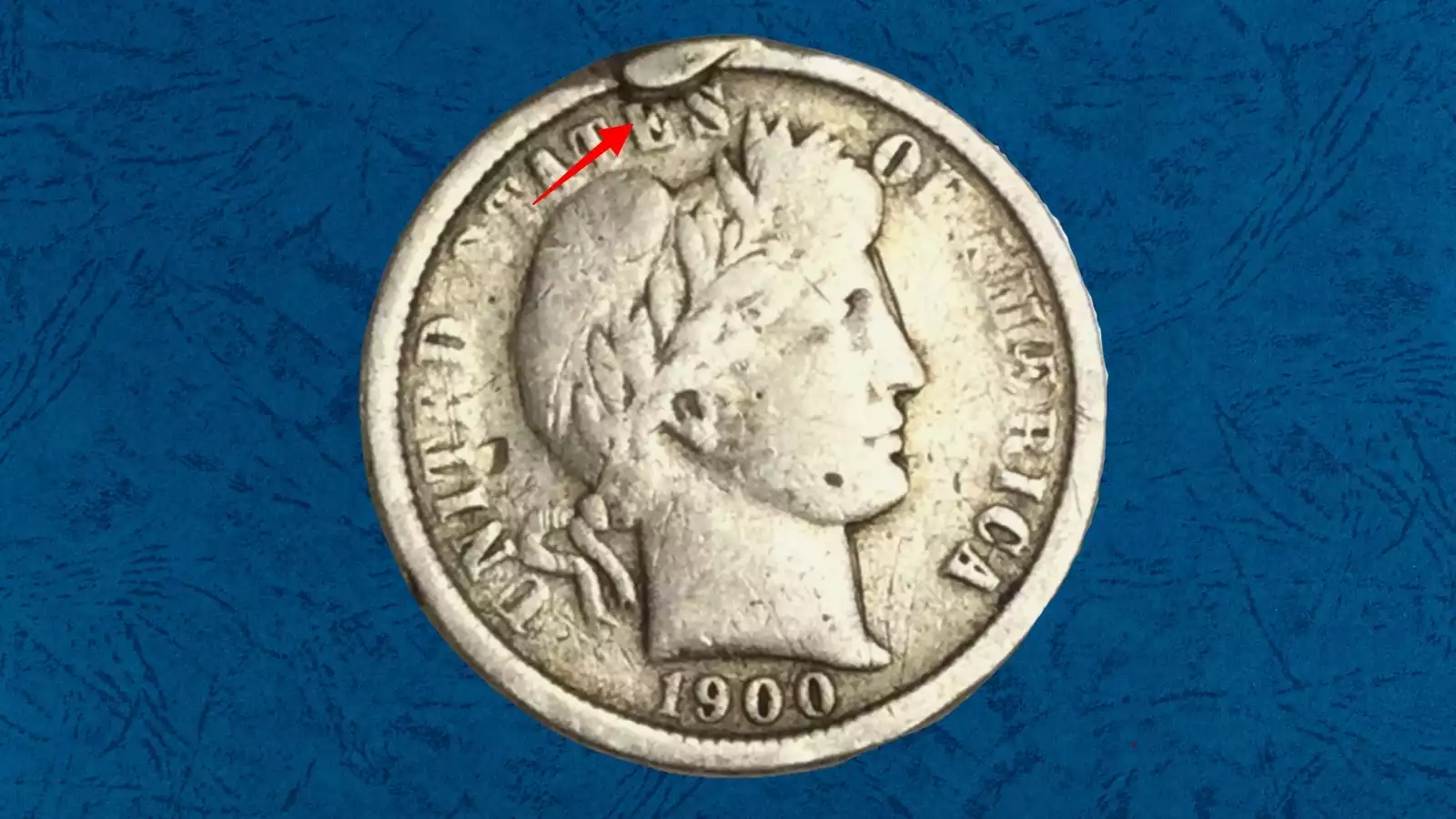
How to spot it

Look for a crescent of plain silver planchet on one side of the coin and a corresponding shift of the full design toward the opposite edge. Measure offset roughly as a percentage. With a 10× loupe, confirm the rim is absent on the blank side.

Mint mark

P (Philadelphia), O (New Orleans), and S (San Francisco) issues all known. Error is die/press independent — any mint can produce off-center strikes during planchet feeding.

Notable

Off-center Barber dimes with 20%+ displacement and a fully readable date are actively sought by PCGS and NGC error specialists. Examples with full date visible at 30–50% offset can realize $300–$500+ at major auction venues like Heritage and Stack's Bowers.

1900 Barber dime with die cud error showing raised blob of metal connected to rim where die broke away Rarest Find

Die Cud Error

$50 – $500+

A die cud forms when a portion of the working die breaks away near the rim during production, leaving a void in the die that fills with metal on every subsequent strike. The result is a raised, shapeless blob of silver metal connected directly to the coin's rim — a permanent and dramatic manufacturing defect that every collector struck from that die received identically. Die cuds are terminal die varieties: once the die breaks in this way, its working life is effectively over, making these errors relatively uncommon survivors.

Recognizing a die cud on a 1900 Barber dime is not difficult once you know what to look for. Examine the rim area carefully under a loupe: a genuine cud is a raised, smooth, irregularly-shaped lump of metal that merges seamlessly with the rim and obliterates whatever design elements were in that area — lettering, the date, stars, or the wreath edge. The raised metal has a soft, rounded appearance unlike any known design element. Die cracks feeding into the cud may also be visible as thin raised lines running from the break point toward the coin's center.

Collector enthusiasm for die cuds is robust, and the premium scales directly with the size and visual impact of the break. Smaller cuds affecting only a portion of a letter add $50–$150 in circulated grades. Large cuds that obliterate two or more letters, a significant wreath segment, or the date numeral entirely can reach $200–$500 or more, particularly in higher grades where the full extent of the error remains clearly defined. Placement on key design areas (over IN GOD WE TRUST or the date) further increases desirability.
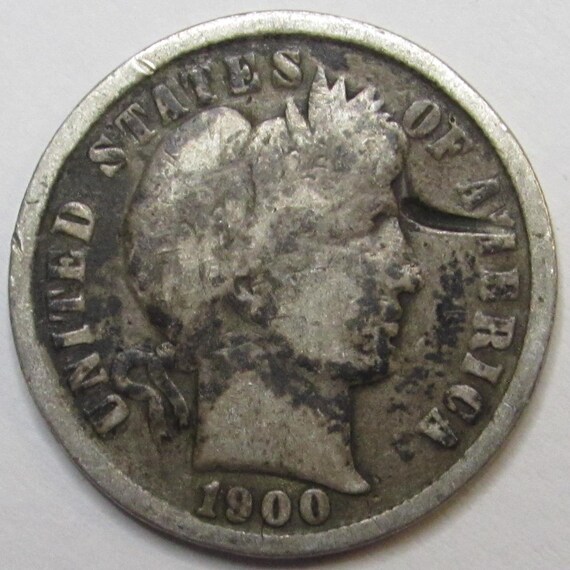
How to spot it

Look along the coin's rim for a raised, smooth blob of metal with no design detail that merges flush with the rim edge. Under 10× loupe, confirm it is raised metal (not damage or a planchet flaw). Die cracks leading to it may also be visible as thin raised ridges.

Mint mark

Documented on P, O, and S issues. Die cuds are press- and die-dependent, not mint-specific. New Orleans issues, with their higher die-wear rates, may have slightly more incidence.

Notable

Die cud errors on Barber dimes are tracked by the Combined Organizations of Numismatic Error Collectors of America (CONECA). Large cuds on identifiable 1900 examples in problem-free circulated condition have sold in the $200–$500 range at specialized error-coin auctions.

1900 Barber dime struck-through-grease error showing missing or mushy LIBERTY letters in headband area Best Kept Secret

Struck Through Grease

$25 – $200+

A struck-through-grease error occurs when lubricating grease or other foreign material packs into the recessed cavities of the working die before a strike, preventing metal from flowing fully into those areas. The affected coin emerges with one or more design elements that appear flat, mushy, or completely missing — not because the die was worn, but because the material blocked the impression. On 1900 Barber dimes, this error most commonly appears in Liberty's headband, causing one or more letters of LIBERTY to appear soft, incomplete, or absent on an otherwise well-struck coin.

The diagnostic challenge with struck-through-grease errors is distinguishing them from simple die wear or circulation wear. The key visual indicator is contrast: a genuine grease error coin will show crisp, well-defined design detail immediately adjacent to the affected flat area, with an abrupt transition between sharp detail and a mushy, smooth surface. Wear, by contrast, is gradual and follows the contours of the coin's highest relief points. Under a 10× loupe, the flat area of a grease error often shows faint ghosting of the missing design element rather than the clean surface produced by circulation.

Value for 1900 Barber dime grease errors depends on where the missing detail appears and how significant the omission is. A coin with one or two missing LIBERTY letters — normally a severe grading deficiency — can actually command a premium when confirmed as a struck-through-grease error rather than wear, since it is a genuine mint error. Minor examples with slight mushiness add $25–$75 over standard pricing. More dramatic examples with multiple missing letters or a fully blank headband on a coin with otherwise sharp details can reach $100–$200 or more, particularly when certified by PCGS or NGC as a genuine mint error.
How to spot it

Look for flat, mushy, or missing design detail — especially in LIBERTY letters — on a coin that otherwise shows sharp, crisp strike quality nearby. Under 10× loupe, a grease error shows a smooth flat area with faint ghost of the missing design, not the gradual contour of wear.

Mint mark

P, O, and S issues all documented. Grease errors are mechanical press events, not mint-mark-specific. Philadelphia coins are most commonly encountered due to higher mintage.

Notable

Struck-through-grease errors on Barber dimes with missing LIBERTY letters can be mistaken for worn coins and undervalued. PCGS and NGC certification as a mint error transforms the coin from a "details" grade candidate into a legitimately valued error coin worth $100–$200+ in problem-free grades.

Think you've spotted one of these errors?

Run it through the calculator — select your mint mark, condition, and error type to get an instant value estimate.

Get an Instant Value →

1900 Barber Dime Mintage & Survival Data

Three 1900 Barber dimes from Philadelphia, New Orleans, and San Francisco mints arranged side by side
Mint Mint Mark Mintage Notes
Philadelphia None (P) 17,600,000 Most common. Well-struck with typical frosty luster.
San Francisco S 5,168,270 Often prooflike fields in early years. Semi-scarce in high grades.
New Orleans O 2,010,000 Key rarity in Mint State. Often weakly struck from worn dies.
Philadelphia (Proof) None 912 Brilliant mirror fields. Early proofs show frosted relief contrast.
Total (all strikes) 24,779,182
Composition specs: 90% silver, 10% copper · Weight: 2.5 grams · Diameter: 17.9 mm · Edge: Reeded · Designer: Charles E. Barber · Series: Barber Dimes (1892–1916)

Survival rates strongly favor Philadelphia examples in all grades. The 1900-O is genuinely scarce in circulated grades above Fine and nearly nonexistent in Mint State. Source: PCGS CoinFacts, coinmintages.com, and Heritage Auctions registry data.

How to Grade Your 1900 Barber Dime

1900 Barber dime grading strip showing four grades from Good to Mint State in a single row

Worn (Good–Very Good, G4–VG10)

Liberty's portrait is worn smooth with little facial detail remaining. The headband is flat and LIBERTY is barely visible or only partially readable. The rim is usually intact. Date and lettering remain clear. Most 1900 dimes found in old rolls or junk boxes fall here. Value: $8–$16 for Philadelphia, $17–$30 for New Orleans.

Circulated (Fine–EF, F12–EF45)

All letters of LIBERTY are visible in Fine (though some may be weak); in EF all letters are bold and the top and bottom headband edges form unbroken lines. Wreath detail remains on the reverse. Hair above Liberty's eye shows moderate wear. This is the sweet spot for most collector sets. Value: $17–$75 for Philadelphia, $95–$400+ for New Orleans.

Uncirculated (AU–MS60–MS63)

Only trace wear on Liberty's cheek and the highest hair strands; the reverse wreath bow may show faint rubbing. Mint luster flows across most of the surfaces. AU coins retain roughly 75%+ of original luster. Full MS coins show complete, unbroken cartwheel luster with no traces of wear anywhere. Philadelphia examples are obtainable; 1900-O in MS is extremely rare. Value: $90–$330+ (Philadelphia).

Gem Mint State (MS64–MS67+)

Full luster, sharp strike, exceptional eye appeal. At MS64 and above, surface quality (contact marks, die quality, luster intensity) separates premiums dramatically. The 1900-P in MS67 sold for $8,625. The 1900-S is well-struck with early prooflike fields and can reach four to five figures in MS66. Full LIBERTY, full rim, and original surfaces are mandatory at these grades.

Pro tip — strike and color designation: For 1900-S examples, look for prooflike (PL) reflectivity in the fields, which was characteristic of San Francisco's early Barber dime production. A PL designation from PCGS or NGC can add 20–40% to realized prices at major auctions. On proof strikes, insist on original surfaces — cleaned or improperly-stored proofs are worth a fraction of problem-free examples, even at the same numerical grade.

📸 Use CoinKnow to photograph your 1900 dime and cross-reference your grade estimate against certified examples in the database — a coin identifier and value app.

1900-O New Orleans Dime Self-Checker

The 1900-O is the most valuable standard business-strike 1900 dime. Work through these four checks to see if yours qualifies.

Comparison of 1900 Philadelphia dime reverse (no mint mark) vs 1900-O New Orleans dime reverse showing O mint mark
Common — Philadelphia (No Mint Mark)

Reverse shows a blank field below the wreath bow. No letter is present. This is the most common 1900 dime with 17.6 million struck. Worth $8–$330 depending on condition.

— vs. —
⭐ Scarce — New Orleans (O Mint Mark)

Reverse shows a clear "O" below the wreath bow. With only 2,010,000 struck and rarely preserved in high grades, this is a key semi-date in any grade — worth $17 to $12,650+ depending on condition.

Run the 4-Point Check

Got a result? Now check what it's worth.

The self-checker tells you what you have. The calculator below tells you how much it's worth based on mint mark, condition, and any errors.

Calculate My Dime's Value →

Free 1900 Dime Value Calculator

Select your mint mark, condition, and any errors — then click Calculate for an instant estimate based on real auction and dealer data.

Step 1 — Mint Mark
Step 2 — Condition
Step 3 — Errors / Varieties (check all that apply)

If you're not yet sure about your coin's mint mark or condition, there's a free 1900 Barber Dime Coin Value Checker tool that lets you upload photos and get an AI-assisted estimate without needing to know any details first.

Describe Your 1900 Dime for a Detailed Assessment

Type what you see and the analyzer will identify likely varieties, errors, and a value range.

🔍 Mention these things if you can:

  • Any letter under the wreath bow (O, S, or nothing)
  • How clearly LIBERTY reads in the headband
  • Presence of mint luster / cartwheel sheen
  • Any raised blobs, shifted design, or mushy lettering

✏️ Also helpful:

  • Overall color — silver-gray, toned, or dark patina
  • Any cleaning, scratches, or environmental damage
  • Full date visibility (all four digits clear?)
  • Rim condition — complete on both sides?

Where to Sell Your Valuable 1900 Barber Dime

The right selling venue depends on your coin's grade and rarity. Here are the four best options:

🏛️ Heritage Auctions

The go-to for AU and Mint State 1900-O, 1900-S, and gem Philadelphia examples. Heritage's Barber dime specialists attract the collector base willing to pay full market for key dates. Best for coins graded MS62 and above, or any example worth $200+. Submit several months in advance for major sales.

📦 eBay

The deepest buyer pool for circulated examples at all price points. Check recently sold prices for 1900 Barber dimes on eBay before listing to set a competitive price. PCGS- or NGC-certified examples consistently sell at a meaningful premium over raw coins. Use "Buy It Now" for worn examples, auction format for AU or better.

🏪 Local Coin Shop

Fast and convenient for lower-grade examples where auction fees would eat into profits. A reputable dealer will offer 50–70% of retail for common circulated examples. For 1900-O or key-date coins, get multiple quotes — values vary widely. Bring your PCGS/NGC slab if you have one; it removes any grade dispute from the negotiation.

💬 Reddit r/Coins4Sale

A knowledgeable community of collector-to-collector buyers. Eliminates dealer margins on both sides. Best for mid-range circulated examples in the $20–$150 range where you've done your research and can accurately describe the coin. Photos and recent PCGS/NGC price guide references required for credibility.

💡 Get it graded first: Any 1900-O or gem-quality 1900-S or 1900-P you believe grades AU50 or better should be submitted to PCGS or NGC before selling. A slab typically adds 20–40% to realized price at auction and completely eliminates grade disputes with buyers. The $30–$45 grading fee is almost always recovered on coins worth $150 or more.

Frequently Asked Questions — 1900 Barber Dime

How much is a 1900 dime worth?
A 1900 Philadelphia Barber dime in Good condition is worth around $8–$12, rising to $30–$50 in Fine and $100–$190 in About Uncirculated. Gem Mint State examples (MS65+) can reach $1,600 or more. The 1900-O New Orleans dime is significantly more valuable, especially in Mint State, where it is considered a key rarity. A top-grade MS67 Philadelphia example sold at Heritage Auctions for $8,625.
What mint marks were used on the 1900 Barber dime?
Three mints produced Barber dimes in 1900. The Philadelphia Mint struck 17,600,000 coins and used no mint mark. The New Orleans Mint struck 2,010,000 coins marked with an "O" on the reverse below the wreath bow. The San Francisco Mint produced 5,168,270 coins marked with an "S" in the same location. Philadelphia also struck 912 proof coins for collectors.
Why is the 1900-O Barber dime so valuable?
The 1900-O Barber dime had one of the lowest mintages of the three 1900 issues at just over 2 million coins. New Orleans Mint dimes of this era are well-known for weak strikes, so fully struck, high-grade examples are extremely rare. In Mint State condition the 1900-O is classified as a key rarity in the Barber dime series, and gem-quality examples virtually never surface at auction. The MS-grade record stands at $12,650, achieved by an MS66 at Heritage Auctions.
What does LIBERTY on the headband mean for grading a Barber dime?
The word LIBERTY inscribed in Liberty's headband is the primary grading indicator for Barber dimes. In Good grade, LIBERTY is barely visible. In Fine condition, all letters must be visible though some may be weak. In Very Fine, all letters are bold and clear. In Extremely Fine, LIBERTY is fully readable with sharp, separated letters and the top and bottom edges of the headband form unbroken lines. Full readable LIBERTY is the key benchmark every collector checks first.
How do I find the mint mark on a 1900 Barber dime?
Flip the coin to the reverse side and look immediately below the bow tying the wreath, just above the rim at roughly the 6 o'clock position. An "O" indicates New Orleans, an "S" indicates San Francisco, and a blank space with no letter means Philadelphia. The mint mark area can be difficult to read on worn coins — a 10× loupe or magnifying glass is recommended for accurate identification, especially for distinguishing a faint "O" or "S" from a blank field.
What are the most valuable errors on a 1900 Barber dime?
The most notable errors on 1900 Barber dimes include Repunched Mint Mark (RPM) varieties on the O and S issues, where a secondary impression of the mint mark is visible under magnification. Off-center strikes — where the design is shifted to one side due to planchet misalignment — can add $50 to $500+ depending on the degree. Die cud errors (a raised blob at the rim from a broken die) are dramatic and can command $150 to $500 or more. Misaligned die errors add a modest $20 to $250 premium.
What is the record auction price for a 1900 Barber dime?
The all-time auction record for a 1900 Philadelphia Barber dime is $8,625 for an MS67 example sold at Heritage Auctions in January 2006. A proof example, graded PR67 Deep Cameo by PCGS, sold at Heritage for $10,500 in May 2022. The 1900-O New Orleans dime holds its own record of $12,650 for an MS66 example at Heritage, reflecting its extreme rarity in high Mint State grades.
Is a 1900 Barber dime made of silver?
Yes. The 1900 Barber dime is composed of 90% silver and 10% copper, with a total weight of 2.5 grams and a diameter of 17.9 millimeters. Based on current silver spot prices, the melt value of a 1900 Barber dime is approximately $1.70 to $2.00, though collector premiums far exceed intrinsic silver value for most examples in collectible grades.
What condition should I expect from a 1900 dime found in circulation?
Most 1900 Barber dimes found in circulation today grade Good (G4–G6) to Fine (F12), meaning Liberty's portrait is worn smooth but the date, lettering, and rim are visible. Very Fine examples (VF20–VF35) still show clear LIBERTY lettering with moderate wear on high points. About Uncirculated coins show only traces of wear on Liberty's cheek, hair, and the reverse wreath tips — these are increasingly scarce since few 125-year-old coins survived handling without wear.
Where is the best place to sell a 1900 Barber dime?
For circulated low-grade examples, local coin shops or eBay offer the most convenience and fair market pricing. For AU and Mint State examples worth over $100, consider a certified auction house like Heritage Auctions or Stack's Bowers, which attract specialist collectors willing to pay full market price. Always have higher-grade or key-date coins (especially 1900-O) professionally graded by PCGS or NGC before selling — a slab can add 20–40% to realized prices compared to raw coins.

Ready to find out what your 1900 dime is worth?

Use the free calculator above — takes under 60 seconds with no signup required.

Calculate My 1900 Dime Value →